| Subscribe Read in Browser |
 |
| Stat Of The Day |
| 11% |
| Pre-retirees may have an emotional preparedness problem. A recent survey asked financial planners how financially ready their clients were for retirement, and over half of professionals said their clients were very prepared. Then, they were asked how emotionally ready their clients were. Only 11% of financial planners said their clients were emotionally ready to call it quits. One of these things is not like the other! If you’re nearing your non-working years, here are some ways to get your feelings as retirement-ready as your finances. |
|
|
|
| The Comparison Trap Doesn’t Retire With You |
Retirement is supposed to mean more freedom and more time for all the things you couldn’t fit in around a full-time job. But for many women, the pressure to "keep up" doesn’t clock out just because you did. Our friends’ glossy social feeds can make a fixed income feel cramped and leave you feeling, well, less than.
"Keeping up with the Joneses" typically gets pinned on families buying bigger houses and newer cars, but lifestyle comparison doesn’t have an age limit – and with more free time on your hands, it can actually hit harder.
"The reality is that comparison can quietly undermine financial and mental wellness, particularly for those living on a fixed income," says Lacy Garcia, CEO and founder of Willow. "Understanding how lifestyle pressure influences financial decisions is an important part of building a healthy and sustainable retirement plan."
The good news? You can protect your financial security without giving up connection or joy. Letting go of the comparison game tends to make room for more of both. For more on defining a rich retirement on your own terms, head here. |
|
|
|
|
|
|
|
| This Week In Your Wallet |
 |
Feeling burnt out at work? It might not be the job itself, but the emotional labor you’re doing on top of it. A Harvard Business School study of more than 350 women in management found 82% spend at least 30% of their week on "caring work" – for example, listening, reassuring, and steadying struggling colleagues. And much of it goes unseen by the people not doing it. Researchers found men often didn't register the emotional labor happening around them at all, while 76% of women said this work falls mostly to women. What are most of us needing reassurance about lately? Artificial intelligence. Last fall, most of the anxiety in this survey traced back to tariffs and the economy. Now it's AI's shadow over the workplace.
🤖 PS, if you’re looking for more on how AI is impacting everything from our workplaces to our budgets, you won’t want to miss Jean’s upcoming chat with award-winning tech journalist Joanna Stern on the HerMoney Podcast. It drops Wednesday!
Retirement…it’s not slowing everyone down. The number of entrepreneurs aged 55 to 64 who are launching new businesses has jumped 22% over the past decade, according to The Wall Street Journal. For some, it’s a way to finally pursue their passion. For others, it’s a chance to try something new – or a way to stretch retirement savings further. Take Margo Clayson, who retired in her late 50s and has spent the past decade expanding her side hustle, The Mighty Microgreen, a company that sells kits people can use to plant everything from broccoli to alfalfa sprouts. "The $800 a month after taxes that The Mighty Microgreen generates wasn’t as important to their budget [before retirement] as it is now that they are living on $3,043 a month in Social Security," the WSJ reports. In other words, retirement has a funny way of changing your perspective: income that once felt "nice to have" can become an important piece of your retirement paycheck.
Believe it or not, we’re more than halfway through 2026…which means it’s time for a mid-year money reset. This 10-minute checkup could save you thousands. Some of it’s the usual: review recent spending, tackle high-interest debt, etc. But don’t skip this one – checking in on your retirement accounts. "Some workers are contributing to a 401(k) or IRA, but their money is not actually invested," explains CBS News. "That's because not all 401(k) plans auto-enroll you into a qualified default investment. For IRAs, cash is the 'de facto default' for direct contributions and most rollovers." |
|
|
|
| The Market’s Riding One Big Theme…Should You Worry? |
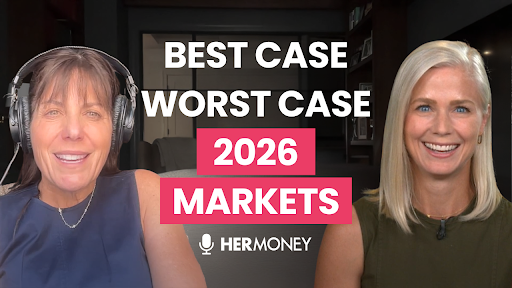 |
Halfway through 2026 is a good moment to check in on more than your budget – your portfolio deserves a look too, especially with one theme reshaping the market’s risk profile. Recently, Marta Norton, Chief Investment Strategist at Empower, joined the HerMoney Podcast to break down everything you need to know.
"Increasingly in the S&P 500 or really any other kind of market cap weighted representation of the U.S. market, you see that it’s concentrated in the Magnificent Seven," Norton says. "A lot of these companies are variations of the same theme. They’re all kind of focused around technology in one way or another, and increasingly AI within technology."
Still, she’s not sounding the alarm about an AI bubble just yet. Her advice? "You don’t want to necessarily put all your chips in the game with some of these names, and you also don’t want to avoid them altogether, because they are a big part of the market," she shares.
Norton’s best-case scenario for the second half of 2026 centers on the AI engine continuing to drive markets forward. "It’s conceivable that we could have a year where the market just continues to deliver. The AI theme is this massive economic engine that’s begun to really show up in the GDP numbers, and that’s creating this growth accelerant that has its tentacles not just in technology."
And the alternative? "My existential worst case is that AI proves to be nothing other than a red herring," Norton says. "It never amounts to more than fun conversations with a chatbot, and doesn’t transform the economy." |
|
|
|
|
| Ask Jean |
 |
| Q: |
Today’s question comes from a member of the private HerMoney Facebook group. She writes: "My daughter and her fiancé want a small wedding with around 60 people. I thought $15K would be enough for the reception, but I was way off. How do people do this for their children? It makes me sad because they’re a great couple who deserve to be celebrated!" |
| A: |
Whether you’re planning a wedding or just reading the headlines about them (guilty – a few of us on the HerMoney team have been fixated lately), they’re clearly on a lot of minds right now.
When it comes to your kids’ weddings, there’s no single "right way" to help. Some parents pick up the whole tab. Others set a number and let the couple figure out the rest. Some let them foot the entire bill. Here’s what the HerMoney community had to say – and some suggestions for a few ways to save: |
|
| ● |
"My niece recently got married and to reduce expenses she had her wedding on a Thursday – wedding venues are sky high on the weekend," says Barbara. |
| ● |
"My parents gave me a sum of money, what they could afford, and I paid for the rest of it along with my now husband," shares Madeline. "It gave me a lot of pride knowing that I was able to pay for something I valued. I worked hundreds of extra hours over almost two years to do it, and it was worth it for me." |
| ● |
"You have to shop venues," says Jinny. "Buffets are also typically cheaper than plated dinners!" |
| ● |
"Consider taking over an entire restaurant and doing a lunch instead of an evening dinner," suggests Ann. "We recently threw a party for 65 folks, great food, more or less open bar, and the total was under $5,000," says Ann. |
| ● |
"With our daughter’s wedding, we told them that we wanted them to work together to plan/budget their entire wedding and that we would pay 50% up to a maximum of $10K," says Jill. "It was the best thing we ever did. They learned how to work as a team and also how to plan, budget and compromise." |
|
| Good luck – and remember, your daughter and her husband-to-be should appreciate whatever you’re able to give. One thing some couples say, looking back, is that they wish they had spent less on their big day and put more toward another goal – like a down payment on a first home. That’s worth keeping in mind too. |
| Submit your questions to Jean here. |
|
|
|
| Things That Save You Money |
|
|
|
|
|
|
|
|
|
| We maintain a strict editorial policy and a judgment-free zone for our community. We strive to remain transparent in everything we do. Website posts and newsletters may contain advertisements, links and mentions of products from our partners. Learn more about how we make money. |
| *This is a sponsored post |
|