| Subscribe Read in Browser |
 |
|
|
|
|
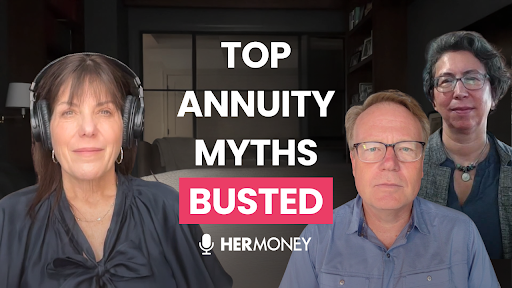
| The Truth About Annuities: Busting Myths And Answering Your Biggest Questions |
 |
Annuities are among the most misunderstood – and perhaps the most underestimated – products in retirement planning. Look into one, and you’ll likely walk away with more questions than answers: What do they actually cost? How do you know if the advice you’re getting is sound? And could a guaranteed income stream be the missing piece in your retirement plan?
To cut through the noise, we brought two of the sharpest minds in retirement income — Michael Finke and Tamiko Toland of LIMRA's Retirement Income Institute — onto the HerMoney Podcast. They busted the biggest annuity myths out there and answered questions straight from our community.
The first myth is one that comes up constantly: annuities are designed to benefit the person selling them, not the person buying them. Experts push back on that. Think of it like working with a mortgage broker: yes, they earn a commission, but they're also doing the legwork to connect you with a product that actually serves you.
"In the same way, someone who may be selling you an annuity is giving you a product that you want, which is a guarantee of a lifetime income in retirement," says Finke. "So there is going to be a commission as part of the sale because there has to be. There’s no other way to get human beings to call people up and explain a complex financial product to them. That’s the compensation for being sold the annuity. And it’s a one-time compensation, and it’s actually baked in."
💡 More from LIMRA: Most people want protected income for life. Few realize that’s what annuities provide. Here’s everything you need to know. |
|
|
|
|
| This Week In Your Wallet |
 |
SpaceX has already gone public, and if Anthropic and OpenAI follow suit as expected, they’ll mint around 12,000 new multi-millionaires, roughly 800 of whom will hold more than $100 million. It sounds awesome, but for the newly wealthy, it comes with challenges (we know, break out the tiny violins, right?). Wealth manager Ross Gerber tells The Washington Post that his phone has been ringing nonstop, with a bulk of the calls coming from SpaceX engineers. As he explains, they’ve spent years building rockets and are now asking questions, like, "How do I retire?" His advice when he sat down with a group of them? "Don't change your life. Don't start buying [stuff] you didn't before." Good advice for anyone who gets a bump in pay – not just new multi-millionaires.
Meanwhile, 401(k) balances just hit record highs – but so did hardship withdrawals. Vanguard reports that 6% of participants tapped their retirement savings in early 2025, the highest share ever recorded, up from 5% the year before. "Pressures such as inflation and rising interest rates contribute to increased financial strain among households, and the streamlining of the hardship withdrawal process has made retirement assets more accessible," researchers say.
Want to make extra cash? Who doesn’t? On HerMoney.com, we’re highlighting 12 side hustles you can start with little to no money. One of our favorites: getting paid to share your opinions. Many businesses rely on customer surveys to decide which products are meeting their needs — and which aren’t. As a survey taker, you decide when you work, you don’t have to leave home, and you have the opportunity to make a little bit of side income. Pay for surveys can range from $7.50 to $20 a pop. Check out the rest of our list, here. |
|
|
|
| Things That Save You Money |
| ● |
Ride-sharing apps may be charging you more than the person standing next to you for the same ride. A Consumer Reports investigation found that Uber and Lyft routinely price the same route differently, depending on the user. For example, in one Kansas City test, 55 people requesting the same route received 29 different prices. The fix? If you're with someone, compare prices before you book. |
| ● |
Fire up the sewing machine – mending is having a moment. Whether it’s the savings, the sustainability angle, or the rewarding feeling of fixing something, people are picking up the needle and thread again. You can too, no experience required. |
| ● |
Jean’s new book, The Forever Paycheck, is coming this fall – and Barnes and Noble is offering 25% off preorders through June 26. Use code PREORDER25 at checkout! |
|
|
|
|
 |
| When we think about hiring a financial advisor, we ask the obvious questions about a person’s credentials, experience and track record. But there’s a whole other list worth considering: |
| ● |
Do they communicate in a way that will work for me? |
| ● |
Do they understand my life stage or family dynamics? |
| ● |
Do they share my values around work, family, ambition, or risk? |
| ● |
Will I actually feel comfortable calling them when I feel scared? |
|
"The financial industry has historically pretended that money is purely rational. It’s not," Lacy Garcia, CEO of Willow, says. "Money decisions are tied to identity, security, independence, and often shame and fear. They’re shaped by how you were raised, what you’ve experienced, and what you’re afraid of losing."
Want to find an advisor who just "gets" you? Start here — then take Willow's short quiz to get matched with someone who aligns with your goals and your personality. |
|
|
|
| Ask Jean |
 |
| Q: |
Today’s question comes from Shelley. She writes: "I’ve never been a fan of credit cards that charge a fee – but you mentioned Chase Sapphire Reserve in a recent newsletter. It charges a $795 annual fee. What’s your take?" |
| A: |
Annual fees can absolutely be worth it, but if – and only if – you actually use the perks.
Take the Chase Sapphire Reserve. Yes, $795 sounds steep… but it comes with a $300 travel credit that’s easy to use, bringing your real out-of-pocket cost to $495. And, there are bonus mileage points for signup…most recently 150,000, now 100,000. Assuming those are worth a penny apiece, that’s another $1,000. Chase estimates that if you used all the card's perks, you'd get $3,000 in value. The math works – if your lifestyle matches the card.
For a more modest example, one HerMoney staffer carries an IHG card with a $99 annual fee. She rarely uses the card, but hangs onto it because it includes one free hotel night per year at an IHG property – a perk she uses annually to stay at hotels where one night would far exceed the $99 fee.
With any credit card that has a fee, the key question to ask really isn’t "is this fee reasonable?" It’s "will I actually use enough of the perks to justify it?" If the answer is yes, that annual fee isn’t really a cost; it can actually end up saving you money. |
|
| Submit your questions to Jean here. |
|
|
|
|
|
|
|
| We maintain a strict editorial policy and a judgment-free zone for our community. We strive to remain transparent in everything we do. Website posts and newsletters may contain advertisements, links and mentions of products from our partners. Learn more about how we make money. |
| *This is a sponsored post |
|


