| Subscribe Read in Browser |
 |
| Today's newsletter is sponsored by |
 |
|
|
|
|
|
|
| A Note From Jean Chatzky |
I’ve been on the road with my new book, The Forever Paycheck, and one thing that’s become absolutely clear is that so many pre-retirees aren’t ready.
Why? They haven’t focused. They’re not sure if they’ve got enough saved or if it will cover the retirement they are anticipating. They are sure that they’re not making the most of their money today — because so much of it seems to be just evaporating. Part of that is, of course, inflation. But part of it is also our own behavior. When we choose to plug in, to pay attention. That time should be now.
If you are 10 to 15-ish years out from retirement, you need a pre-retirement check-up. If retirement is coming for you even faster, you need it even more. Our next FinanceFixx — which incorporates a pre-retirement check-up — starts tonight. Join us. Six short weeks from now, you’ll be glad you did. |
|
|
|
| This Week In Your Wallet |
 |
One of the hottest homeownership trends right now is buying with a sibling. A recent survey found 22% of Gen Z homeowners bought their home with a sibling – up from 12% in 2024 and just 4% in 2023. The New Yorker talked to sisters about what it’s really like to share a roof (and a mortgage) as adults. There’s the good: splitting housework duties and spontaneous social plans…and then there’s the not-so-good (one duo points to a tiff stemming from a couch purchase gone wrong). "The trend reflects a broader economic reality: as housing costs increase and marriage rates decrease, many Americans in their twenties and thirties are choosing to live with – and even purchase homes with – their siblings," The New Yorker reports.
But whether it’s with a sibling or solo…should you be buying at all? The Wall Street Journal makes the case that renting can actually be the smarter money move right now, especially with mortgage rates sky-high. Obviously, buying means you stop paying rent and you win if home prices rise — but there's a hidden cost most people miss: the "opportunity cost of capital." Every dollar tied up in a house is a dollar not invested elsewhere. Case in point: home prices rose about 87% from December 2015 to December 2025. The S&P 500? Up roughly 235% over that same stretch, excluding dividends. As economics professors Michael Luca and Raymond Fisman put it, "These figures aren't directly comparable: A home provides a place to live as well as an investment return, but the comparison illustrates the opportunity cost of tying up your money in a home."
If you have a college-bound child, take note: The U.S. Department of Education opened the Free Application for Federal Student Aid, or FAFSA, on September 23, ahead of the anticipated October 1 launch date. Experts say the sooner you fill out the form, the better your chances are of receiving aid. That’s because some aid is awarded on a first-come, first-served basis, or through programs with limited funds. "The biggest advantage of the FAFSA opening early this year is how quickly students and families can get a sense of what aid they might qualify for," said Rick Castellano, a Sallie Mae spokesperson. |
|
|
|
 |
But paying for college is rarely a "just fill out this form" problem – it's a whole strategy, and one that gets easier with the right advisor in your corner.
Willow helps women beat an industry built for men, connecting you with vetted fiduciary advisors who can help you map out college costs alongside your other goals, from retirement to everyday wealth-building. See what Willow is all about here. |
|
|
|
| Things That Make You Money |
|
|
|
|
|
| The Sinking Fund System That Could Change The Way You Save |
 |
Have you ever found yourself staring at your savings account wondering where all the money went? Or worse, dipping into your emergency fund for something that wasn’t actually an emergency? The problem usually isn’t that we’re not saving. It’s that we’re saving without a system. Everything goes into one pot, and when something comes up, it all starts to blur together.
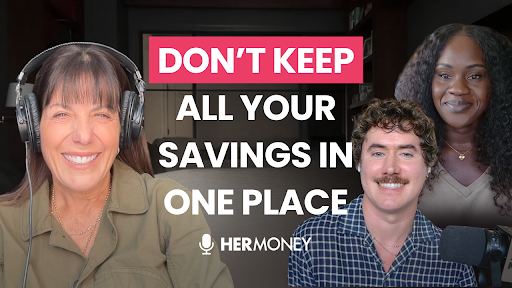
That’s exactly the problem that sinking funds solve. On the HerMoney Podcast, Jean sits down with Sean Pyles, CFP® and host of NerdWallet’s Smart Money podcast, and his co-host, Elizabeth Ayoola, to break the system down.
A sinking fund is a separate, named savings account tied to a specific goal. Instead of one big savings pot you draw from for everything — vacations, car repairs, holiday gifts, emergencies — you have individual buckets, each earmarked for a single purpose. For many people, high-yield savings accounts work well for sinking funds.
The appeal, Pyles said, is twofold: organization and automation. "Ideally, if you’re doing sinking funds the right way, you have direct deposit into each of these accounts," he explained. "So you know that you’re making progress on different financial goals simultaneously, which feels really good. You’re seeing that balance grow each month."
How many sinking funds should you have? There’s really no limit. Pyles currently has six, but that number changes depending on where he is in life. He had one specifically for his wedding last year and another for CFP exam expenses the year before. "You can have a sinking fund for a season depending on your needs, and that can change over time," he said. |
|
|
|
|
| Ask Jean |
 |
| Q: |
Today’s question comes from Christina. She writes: "How do postnups work?" |
| A: |
A postnup – or postnuptial – covers the same ground as a prenup, but you sign it after the wedding. It could be days later… or decades later. A prenup is a document that outlines how a couple will divide assets, handle debts and manage spousal support if they divorce or one spouse dies. And just like a prenup, having a postnup doesn’t mean you’re planning to split; it just means you’re prepared.
"With a postnup, two people are essentially deciding that, after they enter their marriage, they would like to change the nature of property from community property to separate property," explains Kelly DuFord Williams, founder and family law attorney at Slate Law Group. Or, in equitable distribution states, a couple may use a postnup to decide how their property will be divided up after the marriage ends, she explains.
One catch: you can't use a postnup to amend an existing prenup – that document is locked in. But every state lets you fully revoke a prenup, after which you're free to sign a postnup laying out new terms. Take a deeper dive into all things postnups here. |
|
| Submit your questions to Jean here. |
|
|
|
|
|
|
|
| We maintain a strict editorial policy and a judgment-free zone for our community. We strive to remain transparent in everything we do. Website posts and newsletters may contain advertisements, links and mentions of products from our partners. Learn more about how we make money. |
| *This is a sponsored post |
|


