| Subscribe Read in Browser |
 |
| Stat Of The Day |
| 40 |
That’s how old the average student loan defaulter is today – nearly 2.5 years older than pre-pandemic. Here’s what happened: when the payment pause ended in 2023, borrowers had to restart payments after years of getting a pass. Millions didn’t – and by Q4 last year, they’d hit the 270-day federal threshold for default.
If that’s you (or someone close to you), don’t panic – but do act. Start here. |
|
|
|
529s VS. Trump Accounts:
Don’t Choose Yet |
You’ve probably heard of 529 plans. Maybe you’ve opened one. Maybe doing so has been sitting on your mental to-do list for a while. Either way, for parents helping their children pay for college, it’s familiar territory. But now there’s a new account in the mix – Trump Accounts – and you might be wondering: Do I need to rethink everything? Is this replacing my 529?
Lacy Garcia, founder and CEO of Willow, says no. At least, definitely not yet. As she puts it, a 529 is part of the everyday toolkit. "It’s defined, it’s established, and it’s been through enough real-life scenarios, so we know how it behaves over time."
Trump Accounts, on the other hand, are still taking shape. "The idea is there. The framework is there," Garcia adds. "But the version that families will actually interact with day-to-day is still being rolled out."
Bottom line: Don’t rank them – and don’t choose between them yet. Just understand what each one is and where it stands. Garcia breaks it all down here. |
|
|
|
|
|
|
|
| This Week In Your Wallet |
 |
Your car is probably costing you more than you think – and not just at the pump. Total U.S. auto debt has hit $1.68 trillion (up 27% since 2018). That’s the largest volume of outstanding loan debt ever recorded. Now, a new analysis shows the financial ripple effects impacting the nearly 86 million Americans who currently have an auto loan or lease. For example, borrowers with auto loans see significantly faster credit card balance growth across all income levels. For middle-income borrowers, credit card balances surged 31% between 2018 and 2025 – versus just 17% for those without auto debt. So, what can you do to help lower car-related costs? Here are four moves worth making right now:
🚗 Have an auto loan? Check if refinancing can lower your rate.
🚦 Paying too much for insurance? Probably. Compare providers.
🛣️ Driving an older car? An extended warranty could save you from painful repair bills.
⛽ Pause before the pump. See where gas is cheapest in your area.
Millennials are burning the boomer financial playbook. As Kiplinger reports, there are four money habits boomers swear by that millennials are walking away from. One of the casualties? Homebuying. "While some millennials might feel as if buying a home is not an option right now given their finances, others are choosing to continue renting to put more money toward investments and other goals instead," Kiplinger reports, noting that the median first-time buyer is now 38 (up from 35), and their share of the market keeps shrinking.
Menopause isn’t just a life stage — it’s a financial issue. 1 in 5 women have delayed or skipped menopause treatment due to financial concerns. 12% have cut back on essentials just to afford care. Jill Herzig, Chief Brand Officer and co-founder of Midi Health, sat down with HerMoney to dig into how perimenopause and menopause impact women’s careers, finances, and overall well-being. One takeaway – many of us are throwing money at products that simply don’t help. "Moisturizer is not going to change hot flashes, insomnia, or any of the 50-plus symptoms. You want healthcare." So what IS worth spending money on? We break it down here. |
|
|
|
| A Note From Jean |
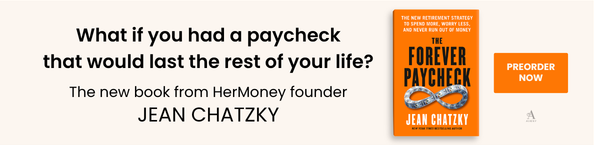 |
The fear I hear most from people approaching retirement isn’t about health, loss, or even dying. It’s this: Will I run out of money?
It doesn’t have to be that way. What if instead of guarding a pile of savings you’re terrified to touch, you could convert it into a steady monthly paycheck that lasts a lifetime – and actually enjoy the retirement you worked so hard to build?
That’s the idea at the core of my new book, "The Forever Paycheck." People who do this spend more (often double what they thought possible), stress less and research even links a "Forever Paycheck" to better health and a longer life.
Over a 40-year career, this is the most important work I’ve done. With so many members of our HerMoney community approaching retirement, it’s a book I want in everyone’s hands because it truly works…regardless of age, portfolio size, or risk tolerance.
"The Forever Paycheck" hits shelves September 8th – but don’t wait. Pre-ordering helps more than you know, and it means your copy lands the moment it’s out. Grab yours here. |
|
|
|
| Things That Save You Money |
|
|
|
|
|
| Uncertainty Is Here To Stay. Here’s How To Stop Letting It Wreck Your Finances. |
We’re living in a moment of profound financial uncertainty – tariffs fluctuating weekly, inflation still running hot and AI reshaping entire industries. According to the Economic Policy Uncertainty Index, five of the highest spikes in uncertainty ever recorded have all happened in the last five years.
We get it. The last thing you want to hear in times like these is to "get comfortable." But that’s exactly what we’re going to suggest you do…with a little help from Simone Stolzoff, author of "How To Not Know: The Value of Uncertainty in a World That Demands Answers."
Stolzoff joined the HerMoney podcast to explain why our desperate search for certainty is actually making us worse investors and decision-makers. One of the most powerful takeaways? Inaction carries its own risk – especially when it comes to investing. If you don’t put your money to work, you face inflation risk. You lose time. You lose compounding.
Stolzoff describes two patterns he sees in people who are particularly intolerant of uncertainty and at risk for inaction: obsessive information-gathering and impulsive decision-making. Neither serves you well. "Maybe there’s a middle road where you gather some information, but you don’t let that completely paralyze you," Stolzoff says. |
|
|
|
|
| Ask Jean |
 |
| Q: |
Today’s question comes from Susan. She writes: "I'm 66 and for years, I’ve thought I need a financial advisor to help me navigate retirement. I keep thinking, though, that anyone who takes me on will probably just be plugging my numbers into an AI. Why can’t I just do that myself and save the fees? Thoughts?" |
| A: |
There’s been a lot of buzz recently about the role AI should – and shouldn’t – play when it comes to our finances. But, if I could distill it into one sentence, it would be this: AI can play a role when it comes to mapping out your financial future, but it’s critical to know its limits.
Andrew Lo, a finance professor at the Massachusetts Institute of Technology and a leading AI expert, has been beating this drum for a while now. As he shares in this piece, there are areas where AI can be helpful in retirement planning – for example, trade-off analyses, scenario explorations and behavioral coaching. "It’s good at narratives around all of these things, explaining the stories about why you should or should not engage in certain behaviors," Lo says.
On the flip side, AI has its weaknesses, particularly when it comes to precise tax optimization, regulatory nuances and arithmetic precision, Lo says. One of the biggest drawbacks, though, is that the bots aren’t bound by fiduciary duty. Your human advisor, on the other hand, is legally required to act in your best interest. As Lo explains, humans can only be taken out of the financial planning equation once fiduciary duty for generative AI is achieved, "and we are definitely not there yet," he says.
There’s also the question of what financial information you’re sharing – and where it goes. Before entering sensitive financial details into any AI tool, it's worth understanding best practices to stay safe.
The bottom line? For a task this consequential – making your money last the rest of your life – sitting down with a financial professional who knows your goals, your fears and essentially, your life, is still worth every penny. |
|
| Submit your questions to Jean here. |
|
|
|
|
|
|
|
| We maintain a strict editorial policy and a judgment-free zone for our community. We strive to remain transparent in everything we do. Website posts and newsletters may contain advertisements, links and mentions of products from our partners. Learn more about how we make money. |
| *This is a sponsored post |
|